
Sky Guide January 2026
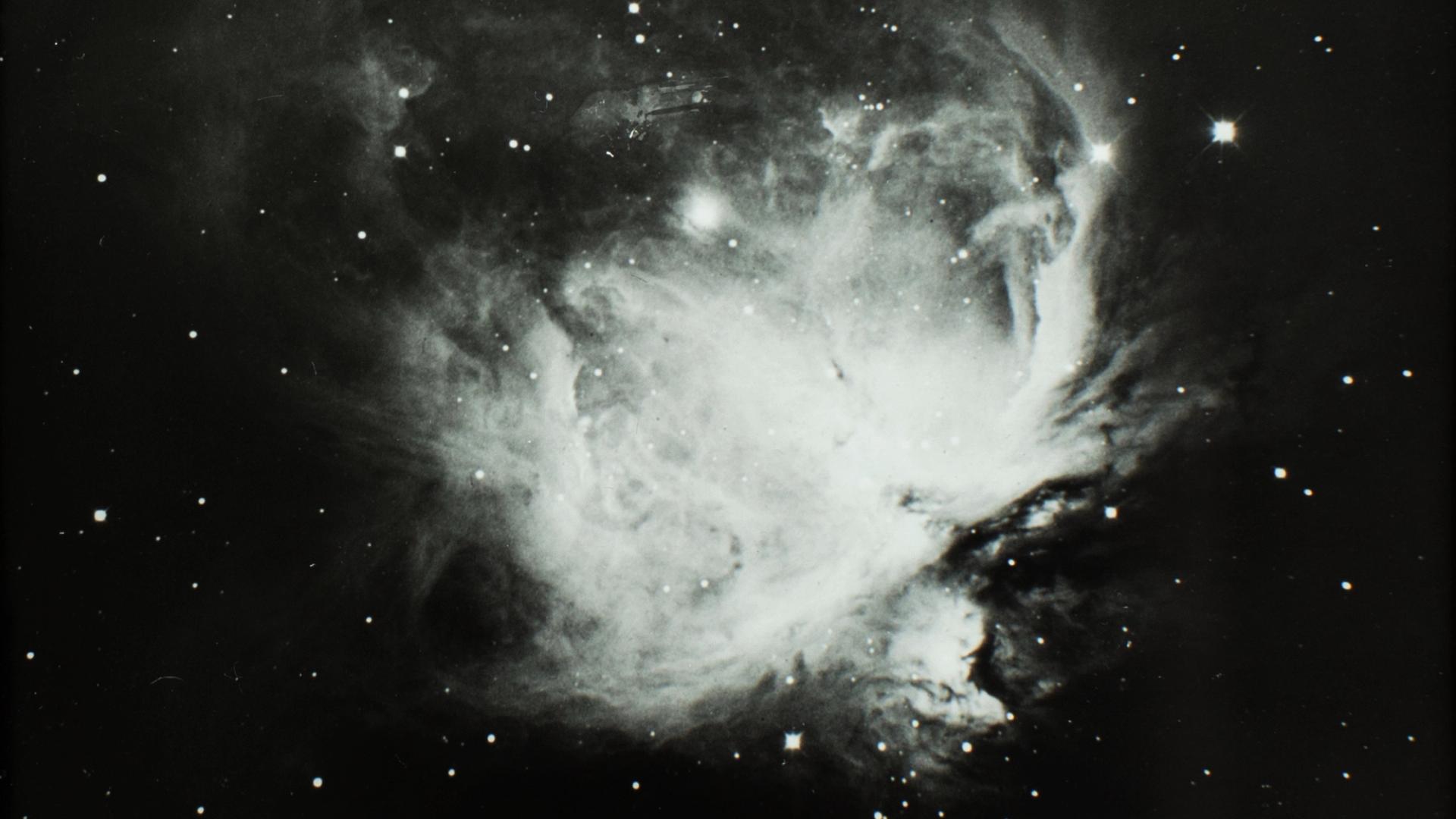
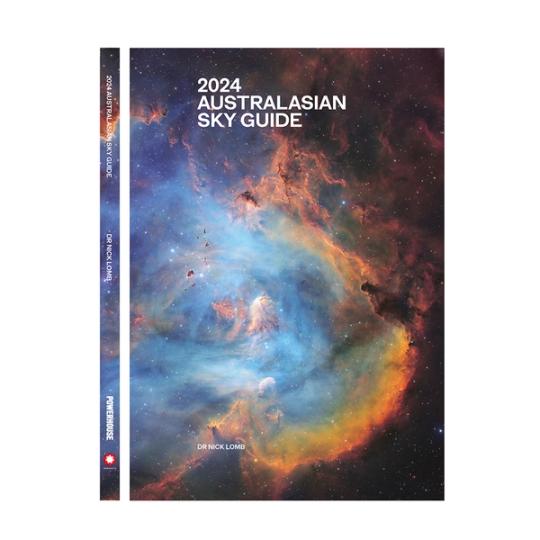
‘Warm summer nights are perfect for gazing, weather permitting, on a moonless night away from the light of cities and towns. From our nearby galactic neighbours of the Large and Small Magellanic clouds to the stunning sight of star formation in the Orion nebula and the giant gas planets of Jupiter and Saturn, there is so much to explore using the 2026 Australasian Sky Guide by Dr. Nick Lomb.’
Moon Phases
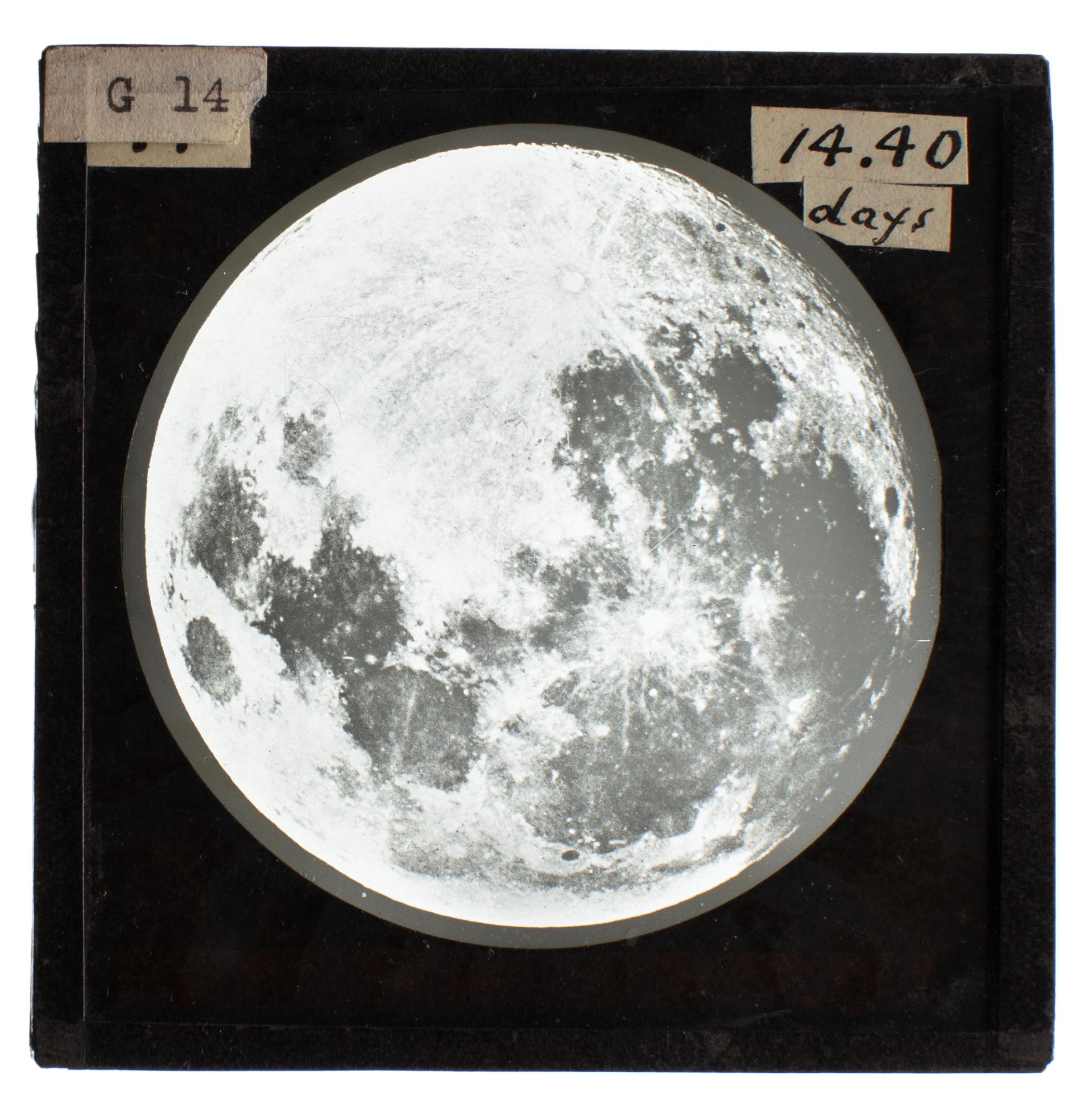
Full Moon Saturday 3 January 9:03 pm AEDT
Earth closest to the Sun (perihelion) Sunday 4 January 4:15 am AEDT
Last quarter Sunday 11 January 2:48 am AEDT
New Moon Monday 19 January 6:52 am AEDT
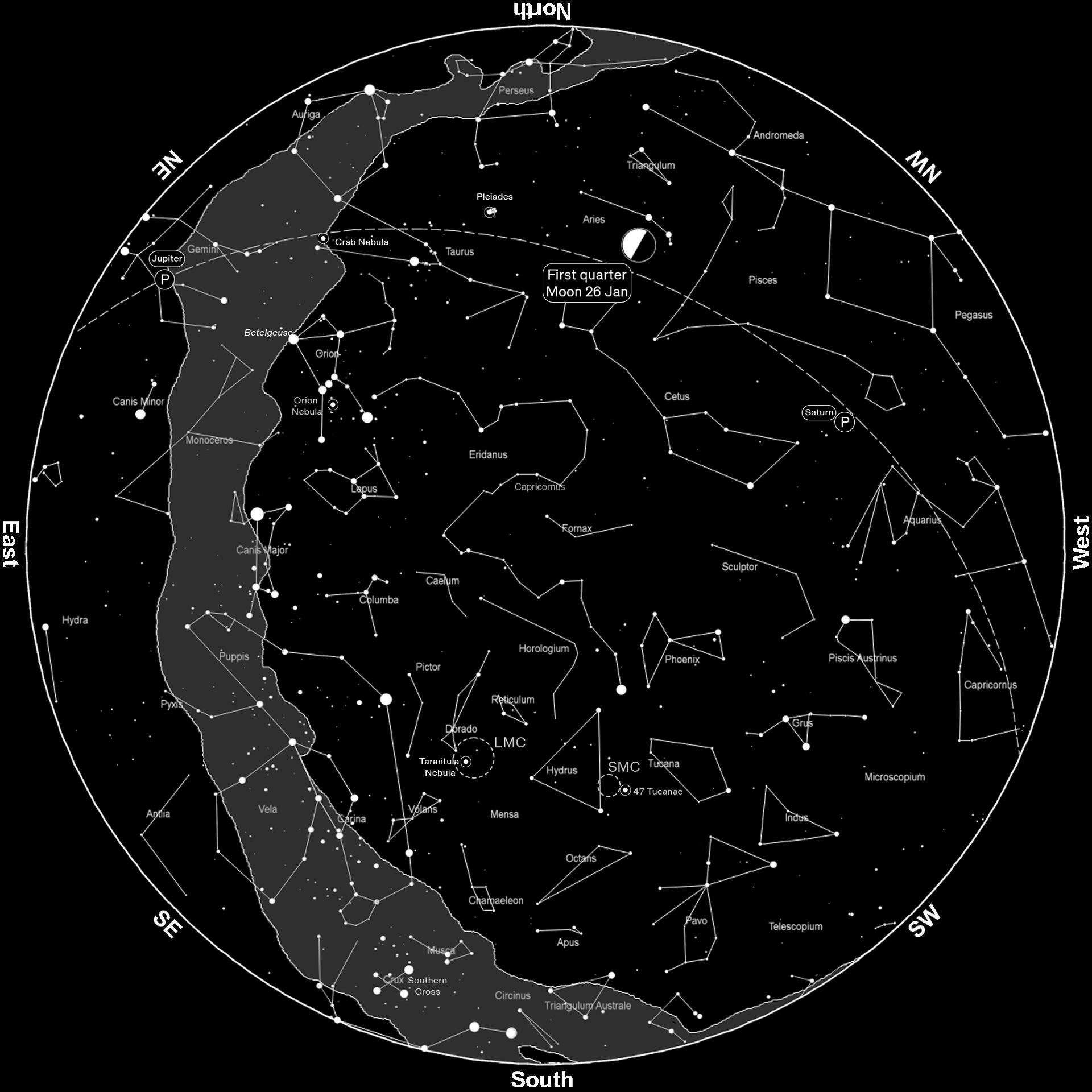
First quarter Monday 26 January 3:47 pm AEDT
Planets

EVENING
The giant planets Jupiter and Saturn dominate the evening sky.
Jupiter is low in the north-east in Gemini. On 3 January, the full Moon is to the left or north of Jupiter, while the following evening, the Moon, now gibbous, is below and to the right or east of the planet. Similarly, on 30 January, the gibbous Moon is to the left or north of Jupiter and on the next evening below and to the right or east. On 10 January, Jupiter is at opposition, that is, opposite the Sun, as seen from Earth, and at its brightest since its last opposition in December 2024.
Saturn is in the west, moving from Aquarius to Pisces in the middle of the month. On 23 January, a thin crescent Moon is below and to the right, or north, of Saturn.
MORNING
Jupiter starts the month in the north-west, disappearing below the horizon at the end of the third week.
Constellations
Constellations are groups of stars that represent mythological figures, fanciful beasts or old scientific instruments. Some have been used for millennia as a tool to share significant cultural stories and to track the passage of the weeks and months. Today they also help astronomers mark out portions of the sky and locate astronomical objects. Those listed below have been selected for their visibility in the evening up to two hours after sunset as seen from the southern hemisphere.
Canis Major the Greater Dog is the companion to Orion the hunter. The brightest star in the constellation, Sirius (also known as the Dog Star), is also the brightest in the night sky as it is close to us – only 8.7 light years away or about 82 million million kilometres and 25 times brighter than the Sun. In about 64,000 years it will be seen as the southern polar star due to the Earth’s wobbling axis of rotation and the star’s proper motion.
Canis Minor the Lesser Dog is an obscure and small constellation usually ignored in the search for its dominant companion, Canis Major, the Greater Dog. To find its one bright star, face north in March – April and look for Sirius in Canis Major. Roughly one hand span (with your hand at arm’s length) below Sirius is the bright star Procyon. And Procyon is just about all there is to the Lesser Dog! Like many constellations it looks nothing like its name. The star’s name comes from the Greek Prokyon meaning ‘before the dog’ and indeed it does rise before bright Sirius and Canis Major from the latitudes of ancient Greece. Canis Minor and Canis Major together are Orion’s hunting dogs.
Carina the keel and the nearby constellations of Vela (the sails) and Puppis (the stern) were part of the huge constellation Argo Navis, which in Greek mythology carried Jason and the Argonauts in search of Aries the Ram’s Golden Fleece. In 1756, Nicolas Louis de Lacaille published his catalogue of the southern stars showing Argo Navis divided into the four constellations we see today. Canopus, the second brightest star in the night sky, can be found in Carina and is a white supergiant star about 313 light years away. It is best seen from February to April high in the south.
Eridanus is one of Ptolemy’s original 48 constellations and represents a river, which begins near the constellation of Orion and ends at the brilliant blue-white star Achernar, the ninth brightest in the night sky, about 144 light years away. Achernar spins so quickly it is the least spherical star known in the Milky Way Galaxy.
Gemini the twins with its two bright stars, Caster and Pollux, sits low in the northern sky between Taurus and Cancer and lacks any bright objects of note. It is best known for the Geminid meteor shower that peaks in the early hours of 13–15 December each year, and for hosting both Uranus and Pluto when they were discovered in 1781 and 1930 respectively.
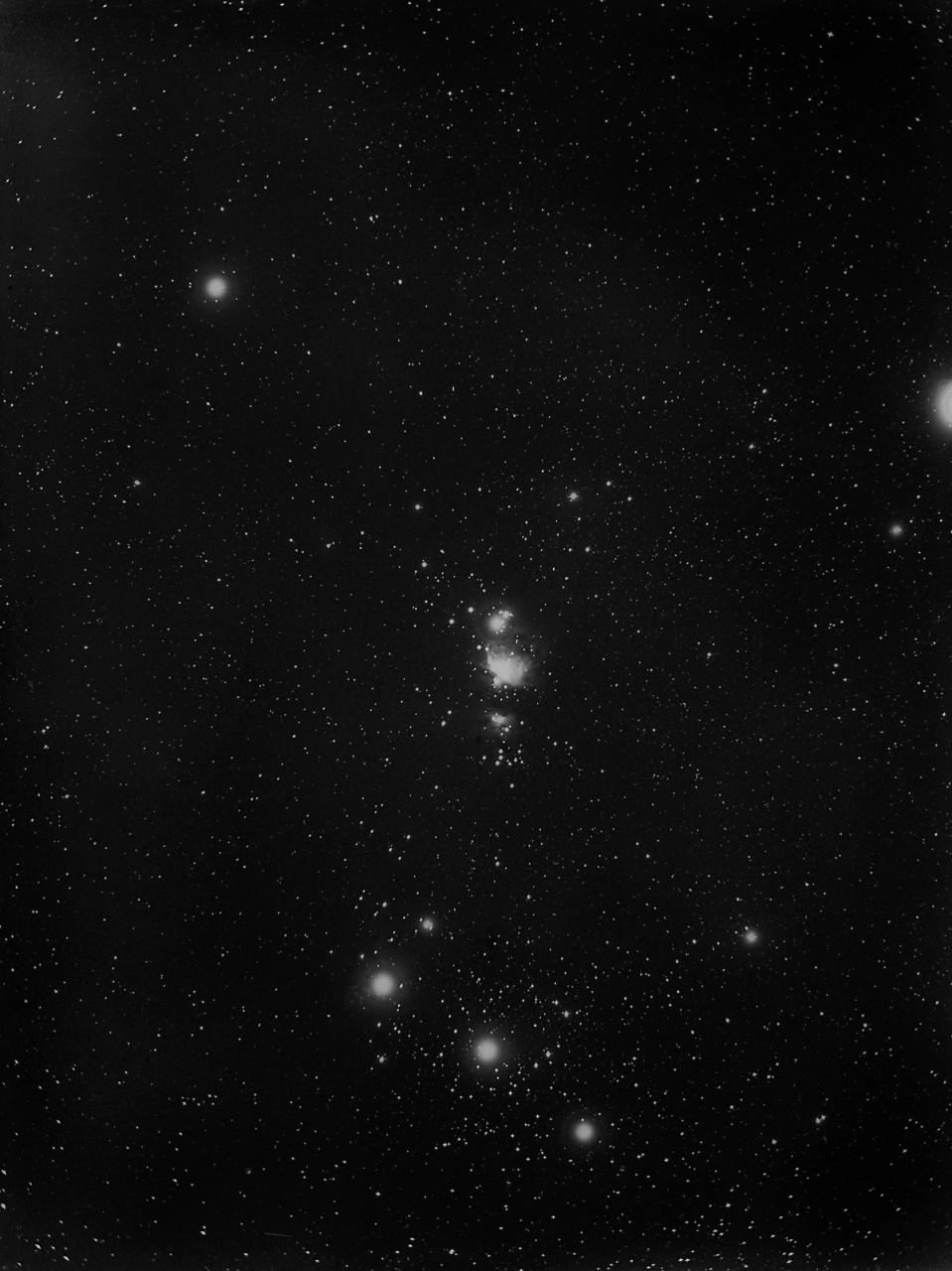
Orion the hunter is one of the original 48 as mapped by Ptolemy and strides across the celestial equator, making it easy to see from both hemispheres. Its likeness to a male figure was probably obvious to the earliest humans. Orion’s brightest star Betelgeuse is one of the few stars to show an intense red colour due to its age and size. The three stars of Orion’s belt at his waist separate his head and shoulders on the right from his sword and knees on the left. The well-known saucepan asterism (a pattern of stars that is not a constellation) consists of a base (Orion’s belt) and a handle (Orion’s sword) plus one additional star at the rim. With binoculars you will see a small hazy glow in the middle of the saucepan’s handle: this is the Orion Nebula, a star birth cloud at a distance of about 1350 light years. The mythology of Orion is complex and often contradictory, though he usually represents a tall, strong and handsome hunter.
Pegasus the winged horse is easy to find low in the north by looking for four bright stars that outline the ‘Great Square of Pegasus’. The Square is large: more than 15 degrees wide and 13 degrees high. In the past all four stars were part of the constellation, though delta Pegasi is now known as Alpha Andromedae.
Taurus the bull is possibly the oldest Western constellation and one of Ptolemy’s original 48. It has the bright red dying star of Aldebaran and the stunning open cluster known as M45 or the Pleiades, a group of very young stars about 445 light years away. Below the horns is the remnant of a star that exploded as a supernova in 1054. It is now called M1 or the Crab Nebula. For the best view you'll need a large telescope and clear northerly view. Its brightest star Aldebaran is 65 light years from the Sun and is 44 times wider but only a little more massive (+16%). It has exhausted its core supply of hydrogen fuel and is now ‘burning’ hydrogen in a shell around a helium core.
Deep sky
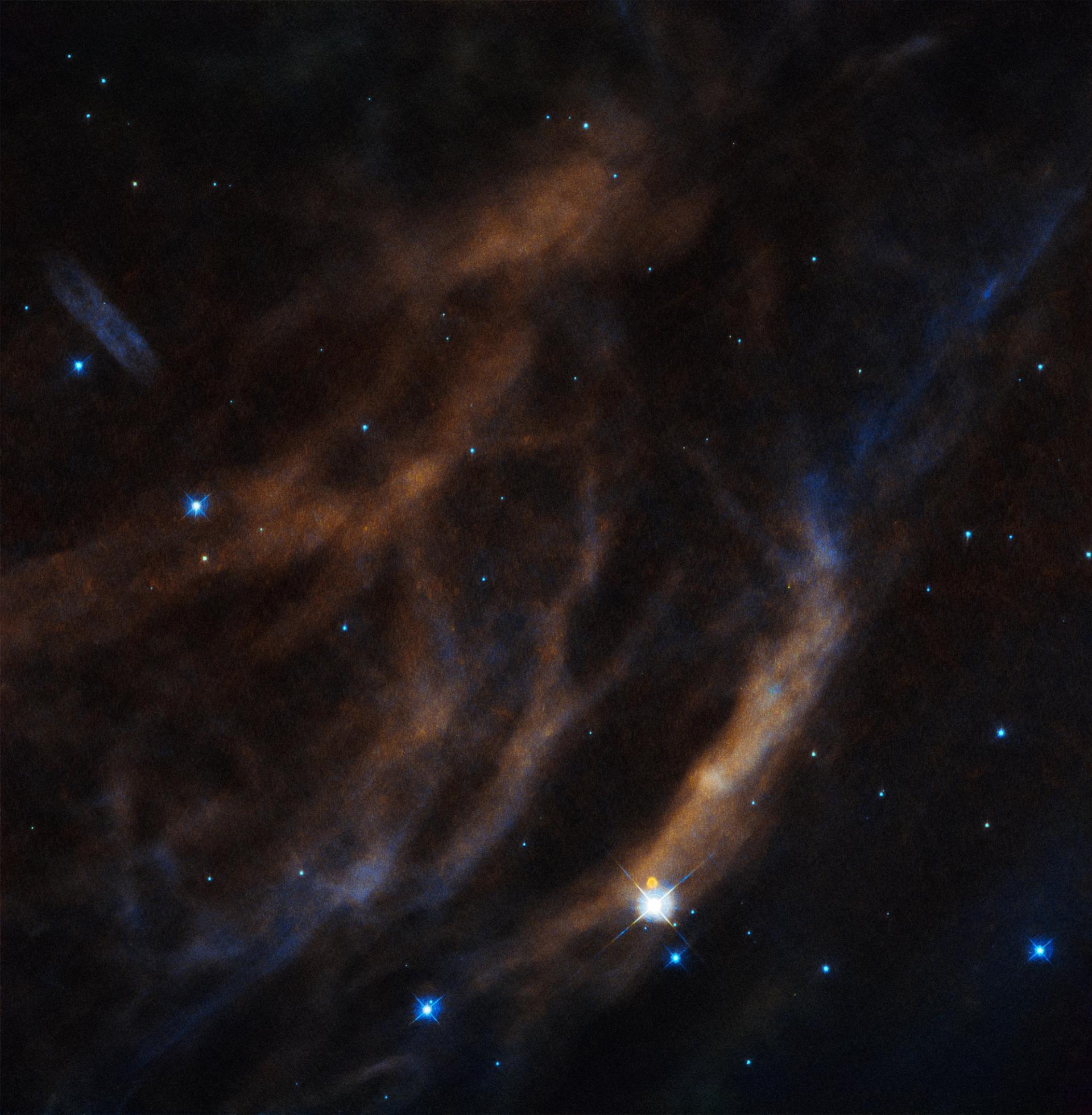
Betelgeuse in the constellation of Orion, which appears during January high up in the northern sky in the evenings. It is one of the few stars in the sky with a noticeable reddish colour as it is a red giant star, which is a star in the latter stages of its life. This is when the star’s central, energy-producing parts become hotter and more compact, while its outer atmosphere expands outwards. As the atmosphere becomes larger, it cools so that it appears only red-hot, hence the red colour.
Red giants can continue the nuclear reactions that power them only if their central parts become progressively more compact and hotter. This causes them to burn their remaining fuel more and more quickly. Soon (in astronomical terms) they run out of fuel completely and, if they are sufficiently massive, explode in a colossal explosion, known as a supernova.
Astronomers have long considered that Betelgeuse is likely to go supernova within a million or so years. However, a recent study suggests the event is likely very much earlier. From the fluctuations in its brightness and theoretical analysis, the study finds that the star will use up all its fuel within 300 years. It will then explode. When it does, it will be visible for months and, at its peak, it will be so bright that it will be visible both during the day and the night.
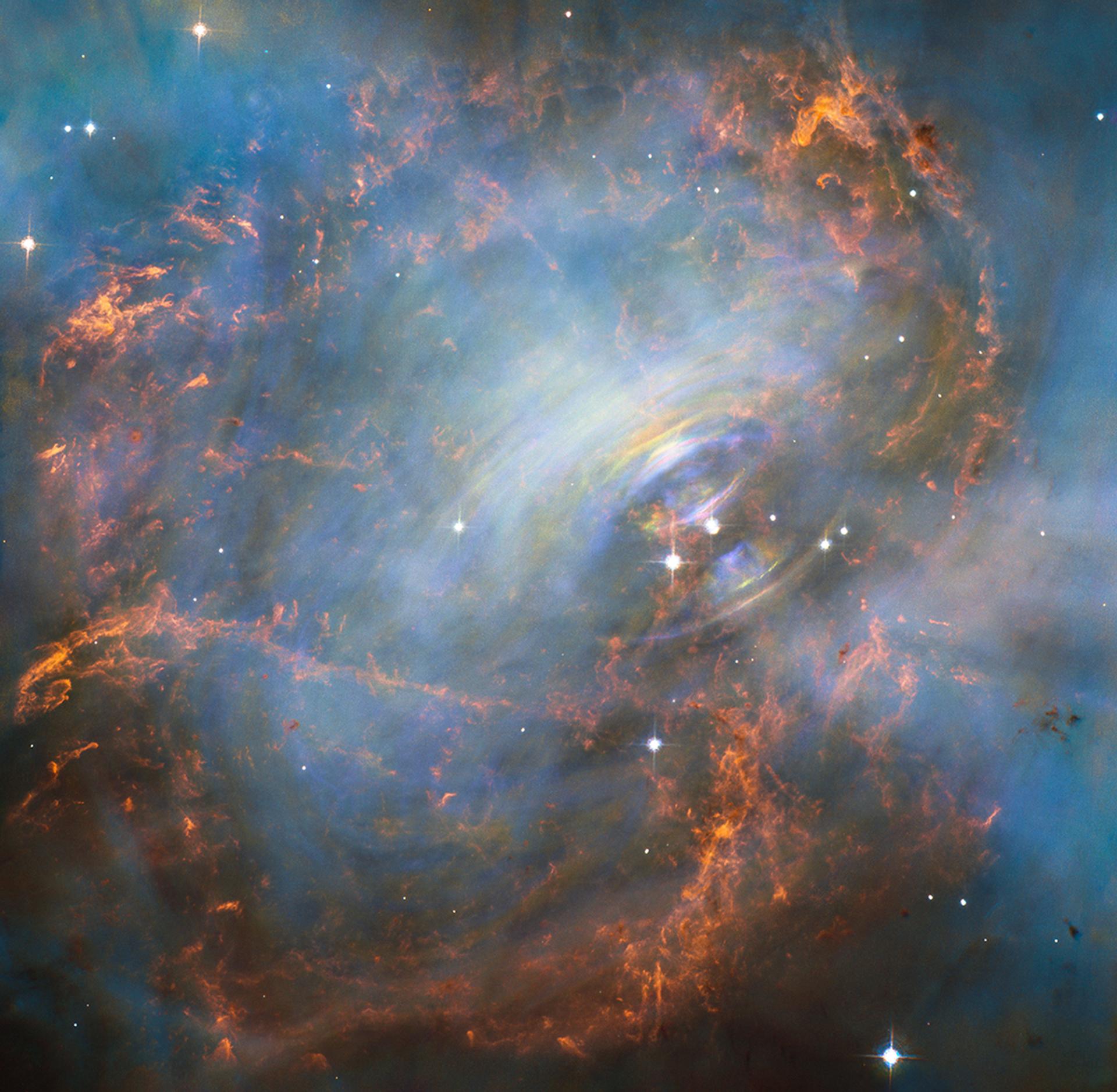
Crab Nebula (M1) is a remnant of a star that ended its life as a supernova visible from Earth on 4 July 4, 1054AD. It was observed by Chinese astronomers and recorded in Native American rock carvings. At the centre of this remnant is a pulsar which currently emits at a rate of 30 pulses per second though this rate will slow by half in the next 1000 years. The Crab Nebula lies about 6500 light years away.
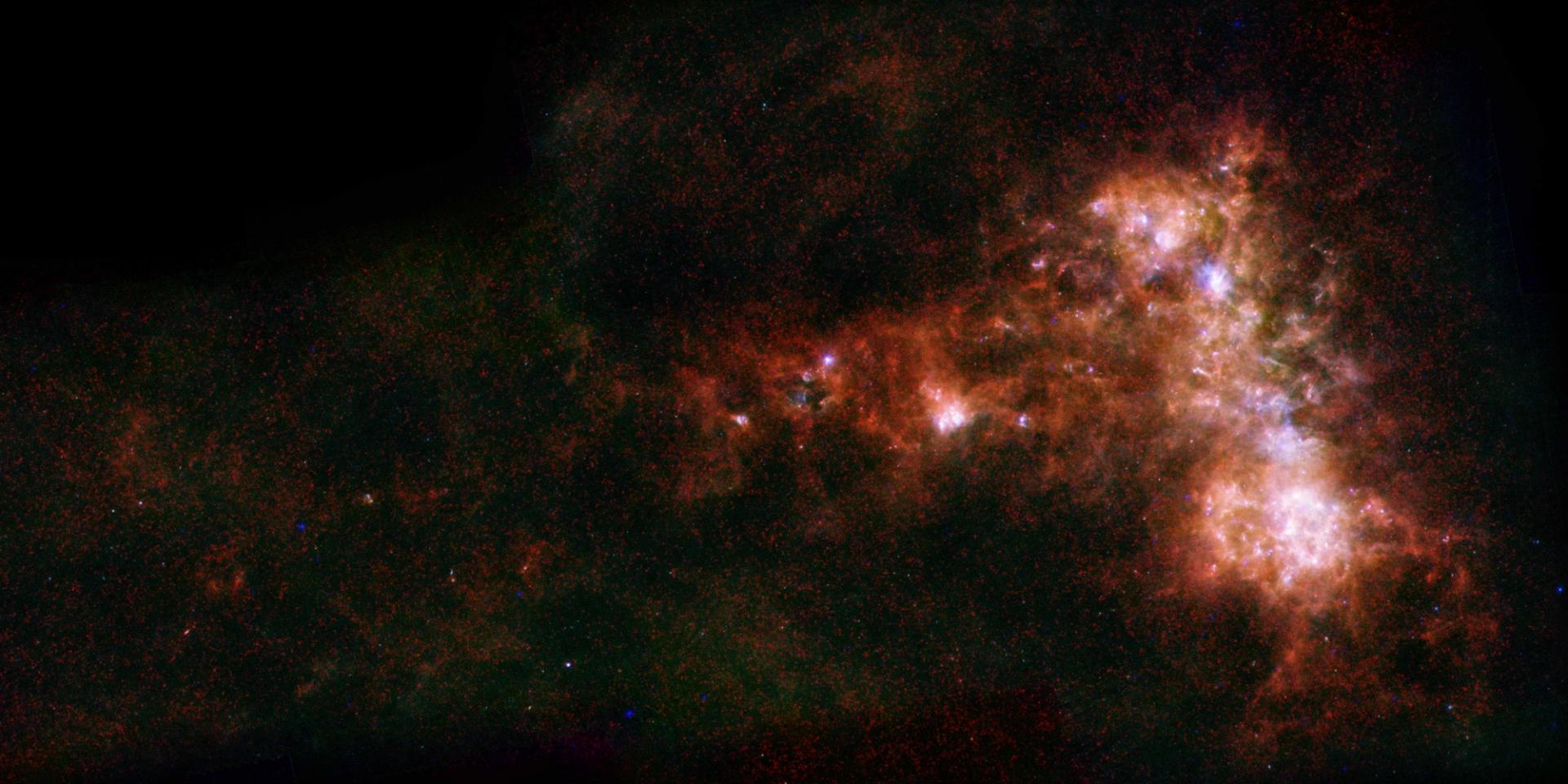
Large and Small Magellanic Clouds (LMC/SMC) are the two satellite galaxies of our own Milky Way. The Large Magellanic Cloud (LMC) is in the constellation of Dorado and is approximately 163,000 light years away. It consists of around 30 billion stars and hosts one of the largest nebulae detected, the Tarantula nebula. The Small Magellanic Cloud (SMC) is in Tucana and is approximately 200,000 light years away. It has around 3 billion stars. The LMC will merge with our galaxy in around 2.4 billion years.
Orion Nebula (M42) is often called the Great Nebula in Orion and is approximately 1344 light years away. The massive star making cloud is 24 light years across with enough mass to form around 2000 stars like the Sun. Its size, distance and brightness (it is the brightest nebula as seen from Earth), make it one of the most studied objects in the night sky. It is easily found as the middle star-like object in the sword of Orion, or the handle of the saucepan as seen from the south. Along with the Moon, M42 is typically one of the first objects to be looked at through a telescope as it shows excellent fine structure including the birth of stars in the innermost part known as the Trapezium Cluster.
Pleaides (M45) also known as Seven Sisters or Subaru, is one of the more famous open clusters visible to the naked eye, sitting within Taurus the bull. Like all open clusters it is a group of young to middle aged stars, in this case around 100 million years old, at about 444 light years away. Many images show the stars associated with a dusty blue nebula, which lies between us and the stars.
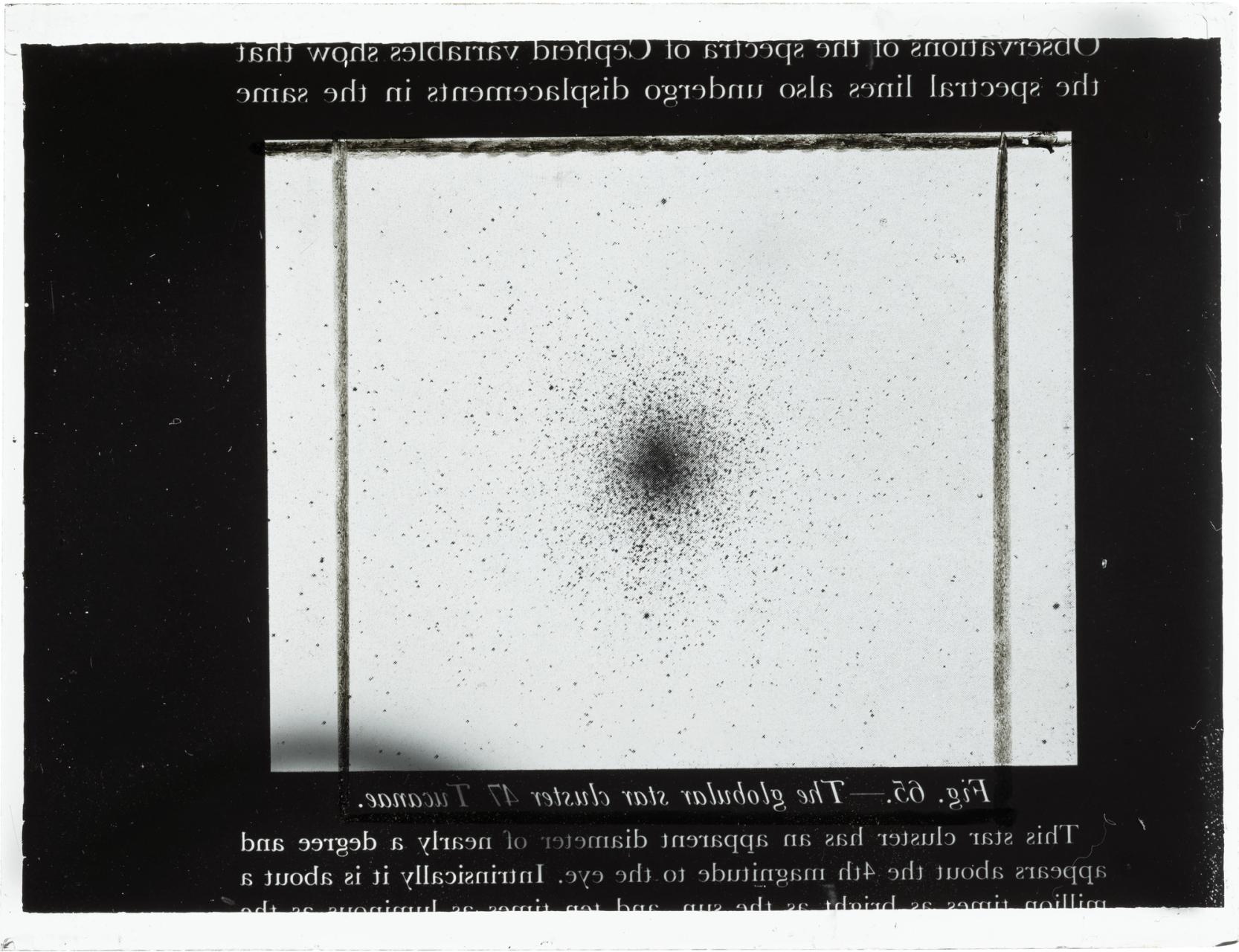
47 Tucanae (NGC 104) is a globular cluster second only to Omega Centauri. It sits beside but is unrelated to the SMC in the constellation Tucana. It can be easily seen away from city lights with the unaided eye due to its very dense star core. 47 Tucana is approximately 15,000 light years from us.
Tarantula Nebula (NGC 2070) is a large hydrogen gas cloud approximately 1000 light years in diameter and part of the LMC at about 160,000 light years. The name ‘Tarantula’ comes from the spider-like appearance of the nebula in telescopes and photographs. At the centre of the nebula is the open cluster R136, which contains approximately 500,000 stars, including some of the hottest and most massive supergiant stars known. In 1987 the first naked eye supernova (SN1987A) since the invention of the telescope occurred in this part of the sky.)
Special Events
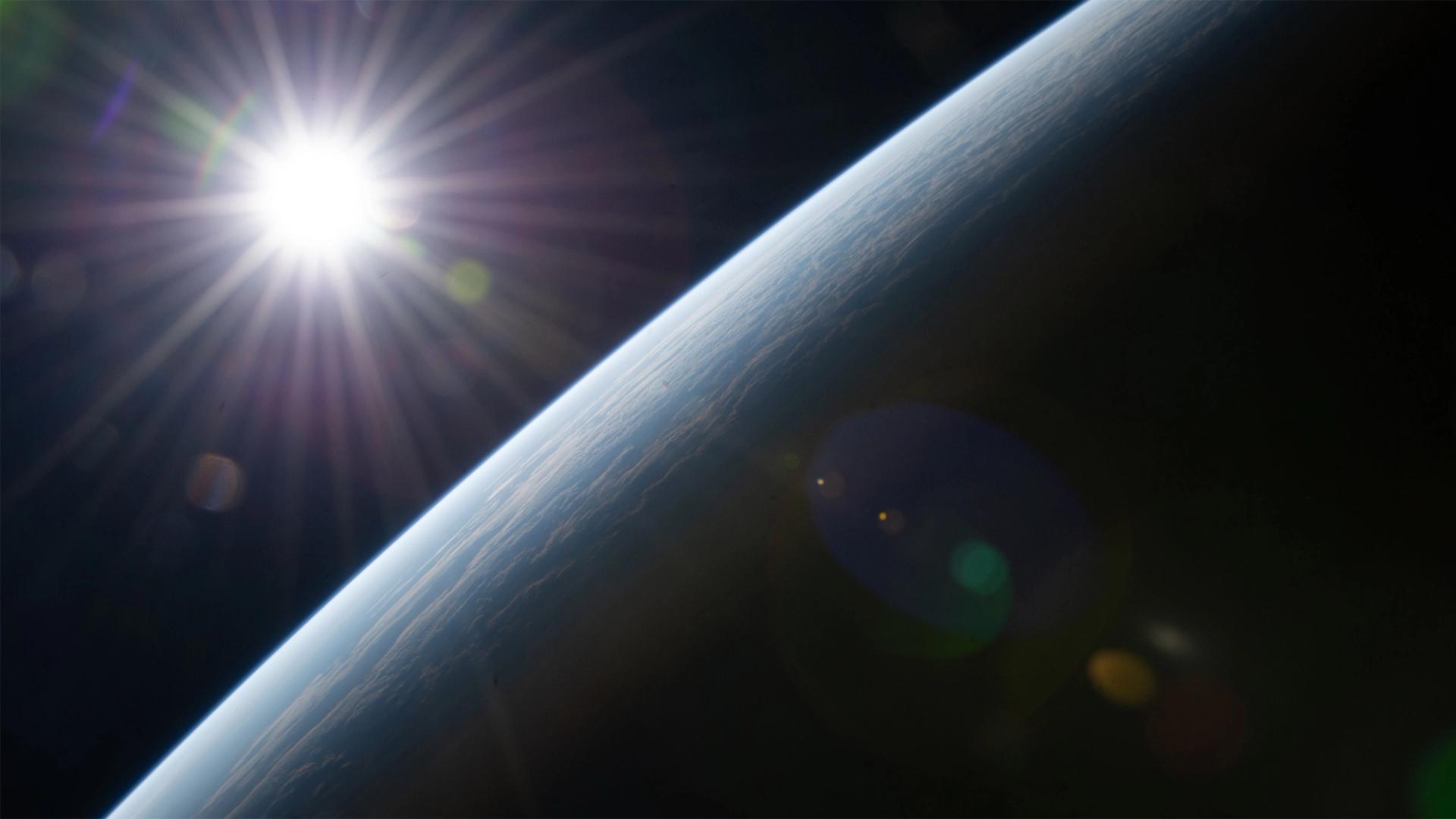
Earth Perihelion 4 January 2026
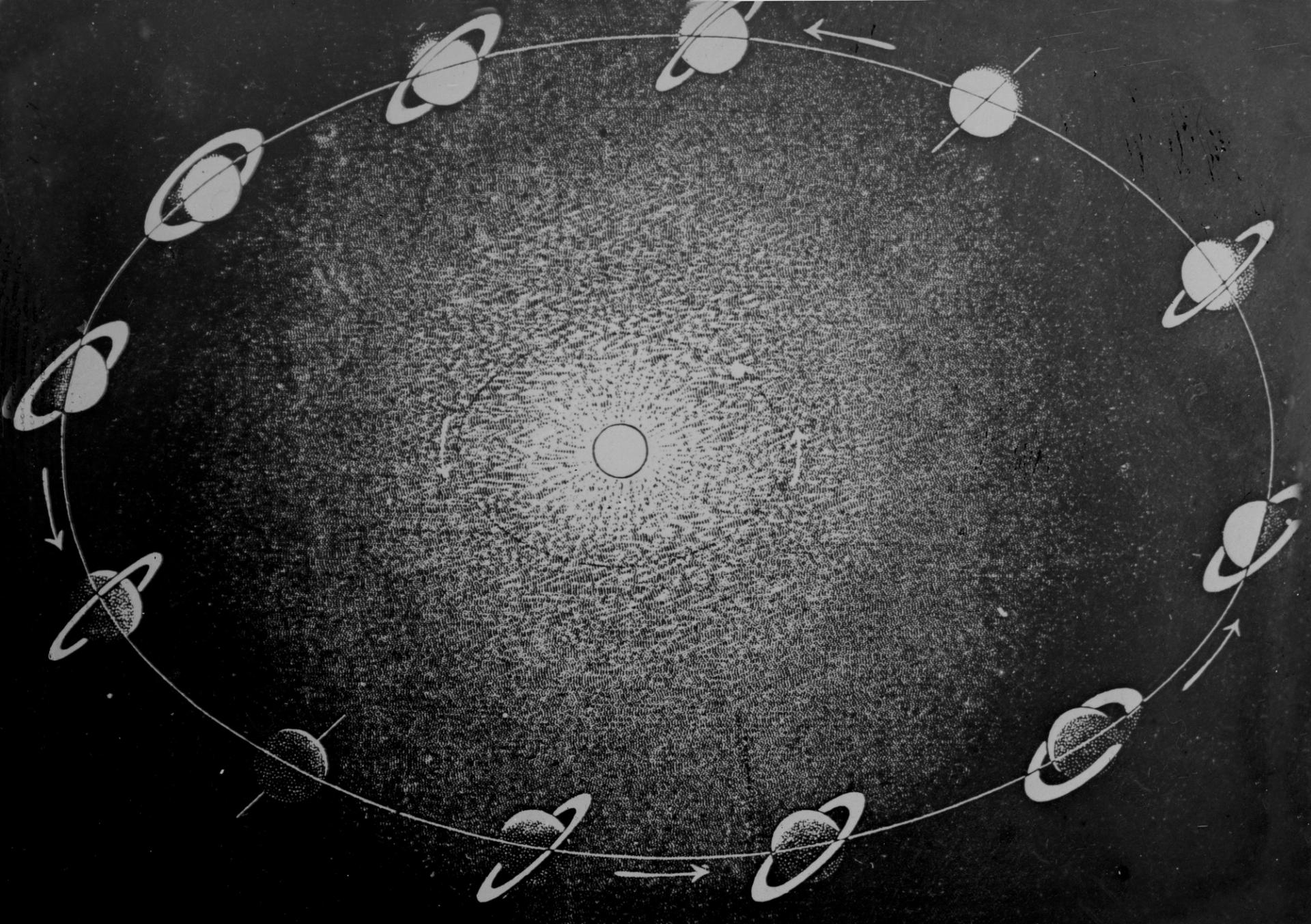
On the morning of Sunday 4 January, Earth is at its closest distance to the Sun for the year. The path of Earth around the Sun is not a perfect circle, but slightly oval-shaped. In early January each year, Earth is closest to the Sun, at a time known as perihelion, while in early July it is at its furthest from the Sun, at a time known as aphelion. The variation in distance between perihelion and aphelion is approximately 3%.
As perihelion occurs at the height of the Australian summer, that could suggest that it causes the seasons. It does not, as is obvious by the consideration that the Northern Hemisphere summer occurs at aphelion. However, the perihelion in January does make the southern summer a little hotter than otherwise and, more importantly, shorter, for the closer Earth is to the Sun, the faster it is moving.
Relief is at hand though, as perihelion will not always occur in January. There are year-to-year fluctuations, but perihelion occurs a day later every 58 years, on average, due to the phenomenon of precession. So, if we wait for about 10,000 years, which is a short time in astronomical terms, perihelion will occur during the northern summer. Then it will be the turn of the people in the north to cope with slightly hotter and shorter summers.
The seasons are, in fact, mainly due to the 23.5° tilt of the axis of Earth as it moves around the Sun. It is summer in the Southern Hemisphere when that half of Earth is tilted towards the Sun. Six months later, Earth is on the other side of the Sun and tilted so that it is summer in the Northern Hemisphere.
Past Months
Shop



Sydney Observatory
Open for pre-booked tours, located on Gadigal land, a national place of connection and scientific research. The site is undergoing heritage conservation works.